The Black Death: Causes, Symptoms and the Medieval Plague That Killed Half of Europe
- Chris Livemore
- Jun 4
- 5 min read

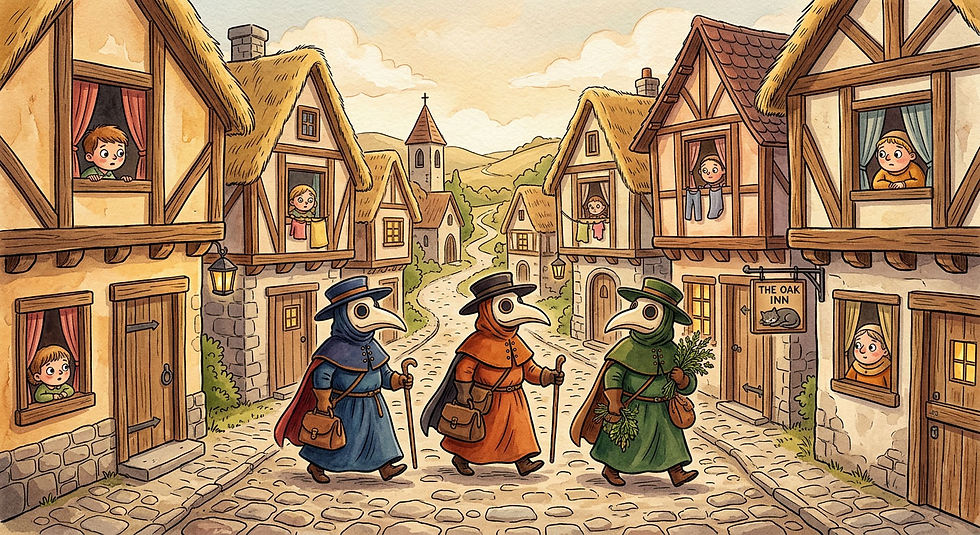
By Chris Livemore
This week I've been looking into how you get a children's picture book deal and the importance of growing a social media following. It is something that wasn't really a consideration even five years ago, but times have changed. I must adapt and find some content that will go viral.
I have been thinking about this carefully. What could be more viral than the Black Death? The cause of an estimated 50 million deaths, you couldn't stop it spreading in the fourteenth century if you tried.
Arguably, this is my most viral content to date.
What was it?
The Black Death was a pandemic of bubonic plague caused by a bacterium called Yersinia pestis, carried primarily by fleas living on rats. It arrived in Europe in October 1347 when ships from the Black Sea docked at the Sicilian port of Messina. People gathering on the docks found sailors dead or dying - it really was not a very good sign of things to come. Those still alive were covered in black, swollen boils that oozed blood and pus.
Sicilian authorities ordered the ships immediately out of the harbour. It was already too late, the history of Europe was about to drastically change in a very brutal way.
The disease had originated in Central Asia and travelled west along trade routes with the extraordinary efficiency of something that didn't need a passport, a ticket, or anyone's cooperation. It reached the Mediterranean by 1347, England by 1348, and Scotland and Scandinavia by 1350.
It moved at the pace of human commerce, which was, in the fourteenth century, faster than most people appreciate and considerably faster than anyone dealing with the consequences would have liked. It was a human disaster of biblical proportions, made possible through excellent trade routes.
How many people did it kill?
Here is where the numbers become genuinely difficult to process. Estimates from modern historians, working from manorial records, burial registers, and population data, suggest the Black Death killed between thirty and sixty percent of Europe's entire population in the six years between 1347 and 1353.
The most reliable recent research points toward fifty percent as the most accurate figure for the worst-affected regions. In England specifically, the population fell from approximately 4.8 million in 1348 to 2.6 million by 1351. A decline of nearly half in just three years. Process that for a moment. It is would have been absolutely terrifying.
In Paris, at the peak of the outbreak, eight hundred people were being buried every day. Florence lost fifty thousand of its eighty-five thousand residents. Across Europe, the total death toll reached somewhere between twenty-five and fifty million people. The global figure, including Central Asia and the Middle East, may have been as high as seventy-five million or even higher!
To put that in some kind of context: the world's population at the time was approximately 450 million. By 1400, it was somewhere between 350 and 375 million. The Black Death reduced the entire human population of the planet by somewhere between seventeen and twenty-five percent.
Medieval people, facing something that killed half the people they knew and for which they had absolutely no explanation, called it the Great Mortality. The Great Pestilence. The name Black Death didn't appear until much later, probably from Scandinavian chronicles describing the darkness the plague left behind.
Whatever you called it, the numbers are beyond any modern frame of reference. You can't compare it with anything, the scale, the horror, the millions and millions of deaths. It was catastophic.
Was it viral?
This is, in the circumstances, perhaps an unfortunate question. But it is a fair one. In the modern sense, did it spread rapidly and reach an enormous audience with minimal effort from its creator, yes. Absolutely and catastrophically yes. The Black Death spread across the entire European continent in six years via trade routes, shipping lanes, and the movement of armies.
It required no advertising budget. It didn't need to understand algorithms. It needed no hashtag strategy. It simply found a densely populated continent with no immunity, no medical understanding of what it was, and no ability to stop it.
Recent research suggests that in addition to flea bites, pneumonic plague, a variant that infected the lungs, spread directly between people through breathing, coughing and close contact. This made it considerably more efficient as a killer than bubonic plague alone and considerably harder to avoid, given that breathing was, at the time, absolutely essential.
There was no treatment. There was no understanding of what caused it. Medieval physicians, working within a framework that understood disease primarily as an imbalance of bodily humours and the wrath of God, recommended aromatic herbs, bloodletting, and the avoidance of bad air. None of these approaches were notably effective.
Some towns tried quarantine, a remarkably modern instinct that occasionally worked. Most did not have the systems or the political will to enforce it.
It changed everything
Here is the part that is mind blowing, and that connects the Black Death to the world we live in now more directly than most people realise. When half your workforce dies, the surviving workers are suddenly in an extremely strong negotiating position.
Before the plague, European peasants were largely tied to the land under the feudal system, legally obligated to work a lord's estate for minimal compensation, with no ability to leave and no possibility of upward mobility. The system had held for centuries because there were always more peasants than there was work.
The Black Death transformed that equation almost overnight.. Lords who needed their land farmed could no longer dictate terms. Surviving peasants could, and did, demand higher wages, better conditions, and freedom of movement. When governments and landowners tried to force wages back down by law, peasants revolted. The Peasants' Revolt of 1381 in England, which saw rebels march on London demanding an end to serfdom, was one direct consequence of the social upheaval the plague had set in motion thirty years earlier.
By 1500, serfdom had largely disappeared from Western Europe. The feudal system that had structured medieval society for four centuries was gone. In its place came wage labour, increased social mobility, and the early foundations of what would eventually become market capitalism.
Some historians also draw a direct line from the Black Death to the Renaissance.
When half the population dies, the survivors inherit. Wealth concentrated rapidly among those who remained. The questioning of religious authority, which had spectacularly failed to explain or prevent the plague, opened intellectual space for the humanism and scientific enquiry that drove the Renaissance forward, sparking huge social change.
Now that is a blog packed full of viral content, explaining how the modern world was shaped in ways we often forget by the fourteenth century's worst catastrophe imaginable.
Join Jack's Shield Wall — the free Good Knight newsletter — at thegoodknightbook.com/shield-wall. New members this month receive a free Guide to Medieval Insults. Which are, given the above, among the more cheerful things the fourteenth century produced. 🏰⚔️


Comments