William Marshal: Was He The Greatest Knight who ever Lived?
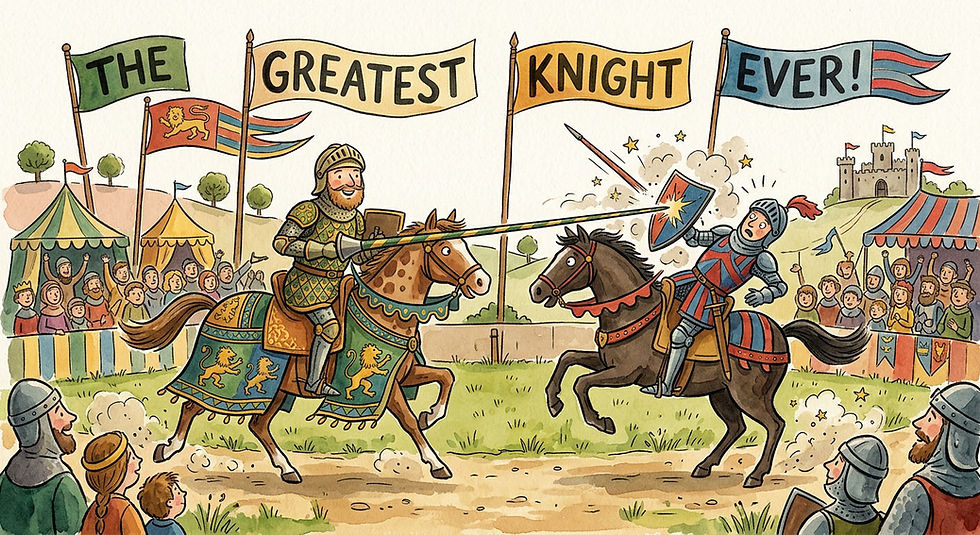
By Jack the Good Knight
There is a question that I get asked an awful lot. Who was the greatest knight who ever lived? The answer, according to Stephen Langton, the Archbishop of Canterbury is William Marshal.
The Archbishop said this shortly after William Marshal died in 1219. He was the most senior churchman in England. And he described William Marshal as the greatest knight that ever lived as though it were a simple statement of fact rather than a compliment.
Eight hundred years later, historians are still largely agreeing with him.
Shall we look at why?
Who was William Marshal
William Marshal was born around 1146 to a minor noble family, which is a good way of saying that he started with almost nothing. No great inheritance. No powerful connections. No castle on a hill. Just a younger son with modest prospects and the kind of physical capability that, in the twelfth century, could be converted into something extraordinary if you were willing to work hard enough and survive long enough.
He was willing and he survived long enough!
His early life contained the kind of detail that would not be out of place in a children's adventure story. At the age of five, young William was surrendered as a hostage to King Stephen to ensure his father's compliance during a siege. When his father defied the king, Stephen threatened to hang the boy.
His father, demonstrating a level of medieval parental confidence that makes modern parenting look cautious, apparently informed the king that he had the means to make more sons and was not unduly concerned ("I still have the hammer and anvil to forge even better sons.") William's father did not win that many awards for good parenting.
Stephen, to his credit and young William's considerable relief, did not hang him.
William Marshal grew up. He was trained as a knight in Normandy. And around 1166, he entered the brutal yet lucrative world of medieval tournaments, essentially staged, full-scale battles fought for ransom and glory. And he was just a tad good at this.
The Tournament Career
William Marshal fought in more than 500 tournaments across Europe over a decade as a professional tournament knight - he was so consistently dominant that he used his winnings to fund his own retinue of knights, which was an almost unheard-of achievement for someone of his background.
At an event in Normandy, he captured ten knights and twelve horses in a single day. His aim was never to kill opponents but to capture them, take their equipment and collect their ransom. It was a model that was both chivalrically correct and extremely profitable for William. He became wealthy not through inheritance but through being, in the most literal sense, the most successful tournament knight in Europe.
On his deathbed, William personally accounted for capturing 500 individual knights during his competition years. And it is believed that he remained undefeated throughout his career. That's undefeated in over 500 tournaments! Across more than a decade of professional competition against the finest knights on the continent.
He was untouchable!
The political career
This is where William Marshal goes from being merely exceptional to becoming someone who was genuinely extraordinary/remarkable. He served under five English kings - Henry II, the Young King Henry, Richard I, King John and Henry III - maintaining royal trust across dynasties in a period when the political landscape shifted constantly and loyalty was a Bear Grylls survival skill.
He served Richard I even after Richard I, as a young rebellious prince, had tried to overthrow his own father. He served King John even when John was losing France and making catastrophic decisions. In 1215, he played an important role in the negotiations surrounding Magna Carta and later reissued it as Regent.
When King John died in 1216 leaving a nine-year-old heir and a country in the middle of a civil war, with a French prince claiming the English throne and half the barons already on his side, the people who needed to save England looked at the available options and chose William Marshal.
He was a spritely seventy years old. Most people would be enjoying retirement, or given the brutality of the medieval period...dead.
As Regent, Marshal showed great political wisdom, re-issuing an amended version of Magna Carta to appease the barons and securing a lasting peace. He defeated the French-backed forces at the Battle of Lincoln in 1217, fighting personally, on horseback, at seventy-one, and by the time he died in 1219 he had stabilised the kingdom and handed it intact to a king who would grow up to reign for fifty-six years.
He then, having saved England, asked to be taken to the Temple Church in London where he was buried among the crusading knights he had always admired. He died peacefully at seventy-three, a truly remarkable feat for a man who had spent five decades being charged at by knights on horses at speed with lances pointed at his chest.
Was he the greatest
The case against is straightforward. History has produced extraordinary knights across many cultures and centuries, figures whose courage, skill and honour are well known. Greatness is not easily reduced to a single name across eight hundred years of knightly tradition.
The case for is also straightforward. He was dubbed the greatest knight that ever lived by medieval chroniclers. He was undefeated in tournament competition. He served five kings without ever betraying one. He upheld Magna Carta at personal risk. He saved England at seventy years old. And he did all of this starting from almost nothing, through nothing but capability, loyalty and the consistent choice to do the right thing even when the easier option was available.
That last quality is the one that interests me most and why I would agree with the Archbishop of Canterbury that William Marshal was the greatest knight who ever lived -he started with nothing and built everything through the consistent application of one principle.
It's choosing what's right that sets a good knight apart.
Inspired by the real history behind The Good Knight? Join the Shield Wall at thegoodknightbook.com/shield-wall - for medieval history, mythical creatures, dad reading tips and the occasional knight who actually saved a country.


Comments