Bayeux Tapestry London Exhibition: Everything You Need to Know Before You Go

Updated: Jul 3
By Chris Livemore
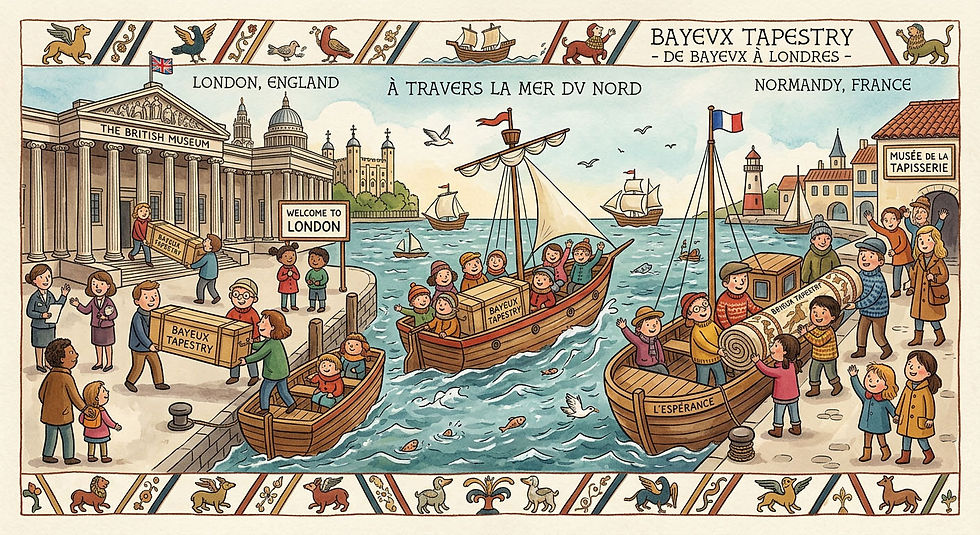
For history geeks (I include myself in that category) something monumental is happening in September 2026. For the first time in nearly a thousand years, the Bayeux Tapestry is returning to the country where many experts believe it was actually made.
It has lived in France since 1077 and displayed in a dedicated museum in Normandy from the early 1980s onwards - The Bayeux Museum. But from this Autumn, the Bayeux Tapestry - which technically is not a tapestry since it is embroidered, which actually means that the world's most famous tapestry should instead be the world's most famous embroidery (a minor detail) - to the British Museum in London.
It will be on display to the British public for the first time since it was made. For history geeks this is like England winning the World Cup and then the European Cup in quick succession and not losing on penalties in the semi-final or final again!
French President Emmanuel Macron announced the loan during his 2025 state visit to the UK. "For the first time in 900 years," he said at Windsor Castle, "the Bayeux Tapestry will follow the same path as the warriors whose stories it tells and land on British soil." It is going to be on display from September 2026 to July 2027.
I am already planning the trip and I might even take the children. You can book yourself some tickets here: https://www.britishmuseum.org/exhibitions/bayeux-tapestry For adults it will cost £33.00 but children under 16 are completely free (phew!).
While it sounds a tad expensive it will really be worth the visit. It is likely to be very, very popular and you might need to wait until later in the year to get your spot!
So, what is the Bayeux Tapestry?
The Bayeux Tapestry is a 70-metre-long embroidered cloth, depicting the events leading up to the Norman Conquest of England in 1066 and the Battle of Hastings itself. It would take Usain Bolt 6 seconds or so to run the length of it. It has 58 embroided scenes, hundreds of individual figures, horses, ships, battles, feasts, a comet, a king dying, and, in the margins, exactly like the medieval manuscripts we've discussed elsewhere on this blog, peculiar small animals and decorative figures that nobody has fully explained.
The ticket cost is worth it for the margins alone!
It is believed that work was commissioned in the 1070s by Bishop Odo of Bayeux, half-brother of William the Conqueror. Experts believe it was embroidered by nuns in Canterbury, which means the story of the Norman Conquest of England was almost certainly embroidered by English hands. The conquerors commissioned a record of their victory in wonderful detail.
Why is it so important?
Quite a good question to ask if you are going to part with £33 for a ticket. The Bayeux Tapestry is not merely art, it is a primary source of a major historical event. A document. A record of events made within a decade of the Norman Conquest by people who were alive when it happened.
It offers incredible details of everyday aspects of the 11th Century.
It shows the construction of William's invasion fleet. The crossing of the Channel. The Battle of Hastings. The death of King Harold, although the precise moment of his death in the tapestry has been debated by historians for centuries, castle construction, clothing, food preparation and even Halley's Comet - an omen of doom for dear old King Harold himself!
Every figure, every scene, every Latin inscription in the border is evidence of what happened in 1066 and how the people of that era understood it.
The Bayeux Museum describes it as a 'masterclass in visual history'. It is hard to disagree.
The first written record of the tapestry is from 1476, when it was recorded in the treasury of Bayeux Cathedral as "a very long and narrow hanging on which are embroidered figures and inscriptions comprising a representation of the conquest of England." In 950 years, it has only been moved on very few occasions.
Napoleon considered bringing it to Paris to drum up public support for his own planned invasion of England. He decided against it. And with that, 1066 was the last occasion that Britain was successfully conquered by anyone.
Why go and see it?
After hanging vertically at the Bayeux Museum for decades, the tapestry is now considered too fragile to be hung. The British Museum will display it flat in a custom case, meaning visitors can see it in a configuration closer to how it was originally designed to be read - a continuous, unrolling story viewed from above.
The British Museum will be insuring it for approximately £1 billion during its time in Britain. One billion. This is genuinely once-in-a-generation. Many people will visit the British Museum dozens of times across their lives without seeing anything quite like this. Book early. Take the children. Stand in front of something nearly a thousand years old that shows the moment Britain became Britain. It really will be an experience.
Then go and have a look at what else the British Museum has, and there is a great deal else, and explain to your children that all of this happened before any of their favourite stories existed.
Jack would consider it an essential educational visit.
Sir Percy would arrive with a museum map, demanding to see where his own exhibit was.
Join Jack's Shield Wall at thegoodknightbook.com/shield-wall. New members this month receive a free Guide to Medieval Insults. Several of which appear in spirit, if not in text, in the Bayeux Tapestry's marginalia. ⚔️🏰


Comments