Norman Castles in England: How the Conquest Changed the Landscape Forever
- Fire Pud the Dragon
- May 4
- 5 min read
Updated: Jul 4

By Fire Pud the Dragon (Mythical Creatures Expert and Part-Time Castle Historian)
1066 was a rather big year for castles in England.
Before this date there were four, maybe five, castles found in the whole country. By 1100, just thirty-four years later, there were over five hundred! That's five hundred in just over three-decades. That is a 9,900% increase - governments could learn a lot from the Normans in terms of hitting house building targets.
The country had never seen anything quite like them before.
The speed, the scale and the sheer scale of ambition of what the Normans built in England after their famous Conquest is one of the most remarkable feats of medieval construction anywhere in the world. And it is also the reason that Jack's castle on the hill exists at all.
Who Were the Normans?
The Normans were, in a pleasing historical irony, descended from Vikings (irony = Vikings were finally defeated at the Battle of Stamford Bridge by King Harold, 3-weeks later the Normans defeated King Harold at the Battle of Hastings).
In 911 AD, a Norse chieftain called Rollo, too large, according to the chronicles, to ride a horse, negotiated a settlement with the King of France, receiving a large territory in northern France in exchange for defending the coast against further Viking raids - Rollo had acquired quite some notoriety for raiding and besieging Paris (AD 885-886). This territory became Normandy, named for the Northmen who settled it.
Within a few generations, the descendants of these Norse raiders had adopted French language and culture, converted enthusiastically to Christianity, developed a sophisticated feudal system, and become one of the most militarily formidable powers in Europe. They built castles across France, conquered southern Italy and Sicily, established crusader kingdoms in the Holy Land, and, on a single October day in 1066, changed the course of English history forever.
The Normans were very good at conquering and were the last people to invade Britain successfully.
The Day Everything Changed
On the 14th of October 1066, William, Duke of Normandy, defeated King Harold II of England at the Battle of Hastings. Harold had already fought one major battle that month, against a Norwegian Viking army at Stamford Bridge in Yorkshire, which he had won decisively. Recently it has been questioned where Harold then marched his exhausted army south at speed to face William, who had landed on the Sussex coast with approximately seven thousand men and a very clear set of intentions. It is more likely that Harold sailed down the coast after it appears that the Victorians mistranslated some text about this.
The battle lasted most of the day. Harold's army held the ridge at Senlac Hill in a shield wall, the same formation we have discussed previously in the Shield Wall blog, repelling Norman cavalry charges for hour after hour. It was only when parts of the English line broke formation to pursue retreating Normans that William's forces found their opening. If the line hadn't broken then it is likely we wouldn't have the castles we see all around Britain today.
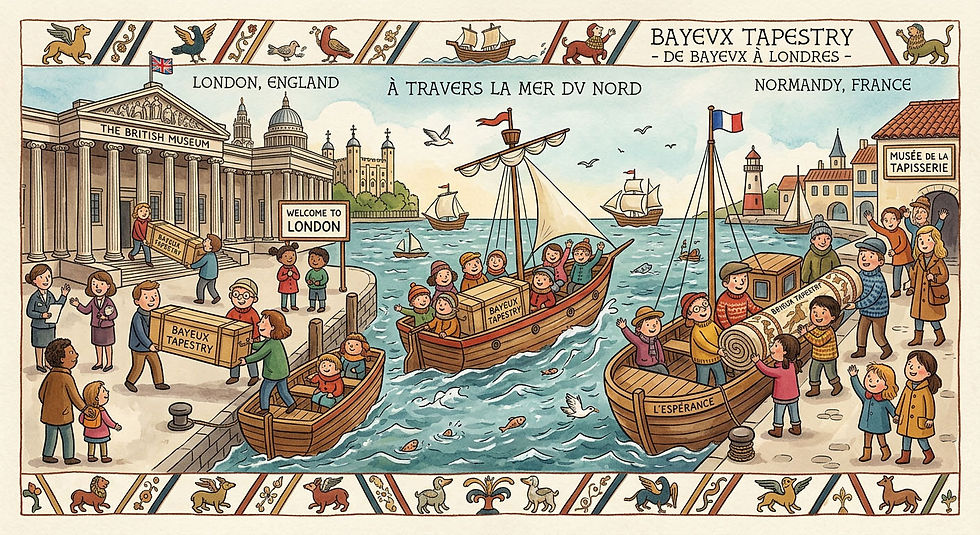
Harold was killed. The exact manner of his death, famously depicted in the Bayeux Tapestry, remains historically disputed, but the outcome was not. By nightfall, the last Anglo-Saxon king of England was dead and William was going to be the new king.
Five Hundred Castles
The Norman castle was not simply a building. It was a huge statement, a military installation, a seat of administration and a very clear message to the surrounding population about who was now complete and utterly in charge. The ultimate power move.
The earliest Norman castles were motte-and-bailey constructions, fast to build, effective and immediately intimidating. The motte was a raised earthen mound, sometimes natural, sometimes artificial. On top sat a wooden tower. Below was the bailey, an enclosed courtyard containing the buildings needed for daily life. The whole thing was surrounded by a ditch and a wooden palisade.
A motivated Norman garrison could construct a basic motte-and-bailey castle in a matter of days.
William's forces reportedly built one at Hastings before the battle had even taken place, a portable, prefabricated structure brought across the Channel in pieces and assembled on the beach. It is thought that as many as 1,000 motte and bailey castles were constructed by the Normans in England!
Over the following decades, the wooden structures were replaced with stone. The towers became keeps. The palisades became curtain walls. The ditches became moats. The motte-and-bailey became the stone castle that children draw when asked to draw a castle and the type that Jack the Knight calls home. There are still around 90 that you can go and visit today.
William built castles at strategic locations across England with systematic efficiency. London got the Tower of London, begun in 1078, its White Tower still standing today as one of the most visited historic buildings in Britain. Windsor got a castle that remains an official royal residence nearly a thousand years later. York got not one castle but two, built on opposite banks of the River Ouse to control the city from both sides.
Norwich, Lincoln, Durham, Exeter, Warwick, Colchester, Rochester, wherever the Normans needed to control a city, a river crossing, a road or a region, up went a castle. By the end of William's reign in 1087, England was the most heavily castled country in Europe.
Why the Castles Mattered
The Norman castle served four distinct purposes simultaneously, and understanding all four explains why they were built so fast and in such numbers.
The first was military: A castle garrisoned with even a small Norman force could control the surrounding area for miles. An attacking army that bypassed a castle risked being cut off from behind. Besieging a well-provisioned castle could take months or years. The castle made the Normans extraordinarily difficult to dislodge even when significantly outnumbered.
The second was administrative: The castle was the centre of Norman governance, the place where taxes were collected, disputes resolved and justice administered. England's new rulers needed to manage a country they had just conquered with a relatively small number of people. The castle made this possible by concentrating power in a single, defensible location.
The third was psychological: A castle on a hill, visible for miles, permanent and imposing, communicated something to the local population that no proclamation could match. The Normans are here. The Normans are staying. Resistance is futile. The speed with which castles appeared across England after the Conquest was not accidental, it was a deliberate programme of visual dominance.
The fourth was social: The castle was the home and seat of the Norman lord, around which the feudal system of medieval England organised itself. Every knight owed service to a lord. Every lord owed service to the king. Every castle was a node in a network of obligation and power that stretched from the smallest village to the throne itself.
This is the world Jack inhabits. The castle on the hill is not simply where he lives, it is the entire social, political and military structure of the medieval world made physical. I will be following up this blog with details about the best castles to visit in Britain.
Join Jack's Shield Wall at thegoodknightbook.com/shield-wall. New members this month receive a free Guide to Medieval Insults. 🏰⚔️


Comments