The Vikings, Alfred the Great and the marsh - how a fugitive king saved England
- Chris Livemore
- May 4
- 4 min read

Updated: Jun 8

By Chris Livemore
It is January 878 AD. The greatest Viking warlord in England launches a surprise midwinter attack on the Saxon king’s base at Chippenham. The king, caught off guard, his army scattered, flees into the freezing Somerset marshes absolutely defeated.
He is hiding in a swamp. He has lost almost everything. And he is the reason England exists as it does today. His name is Alfred. But you may know his as Alfred the Great - the only English monarch ever to receive that title. The story of how he went from a fugitive in a marsh to the man who saved England is one of the most extraordinary moments in the entire medieval period.
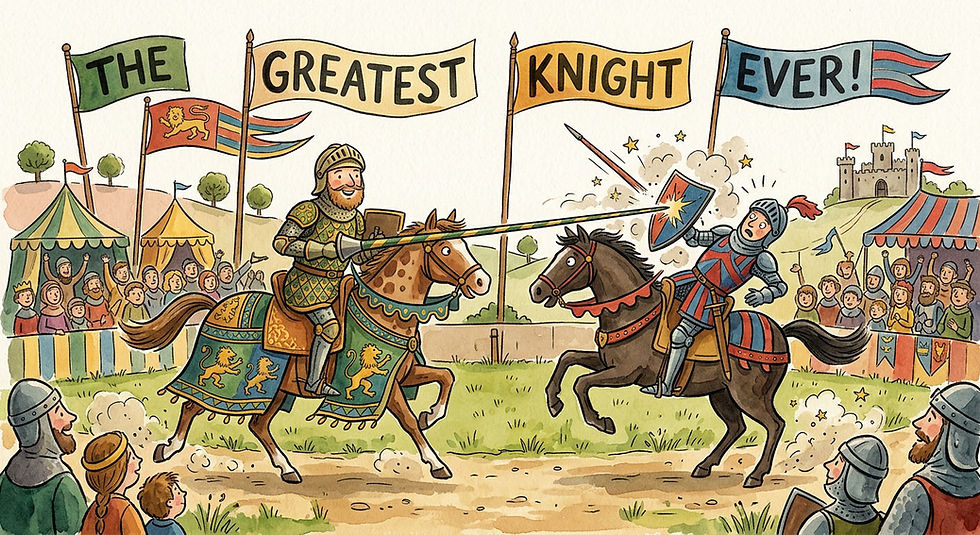
It also has several qualities in common with THE GOOD KNIGHT series. A small, outnumbered figure. A situation that looks completely hopeless. A quiet determination to do the right thing when nobody is watching. And an unexpected comeback that nobody saw coming.
Jack would 100% have been one of Alfred's close friends - and Alfred certainly could have used a fire breathing dragon to help him battle the Vikings!
First up who were the Vikings?
The Vikings initially came as raiders in 793 AD, attacking coastal monasteries and settlements. Over time, their ambitions grew and they began establishing permanent settlements and kingdoms. By the middle of the ninth century, a force so large it became known as the Great Heathen Army landed in East Anglia and began conquering Anglo-Saxon England.
In fourteen years, the Vikings had deposed every single Anglo-Saxon king, forging a network of kingdoms stretching from the Scottish Lowlands to the heathlands of Dartmoor. By 878, only one Anglo-Saxon king remained undefeated. Alfred of Wessex.
And then, in January of that year, the Vikings came for him too.
The Marsh
In early 878, the leader of the Great Heathen Army, Guthrum, forced Alfred into hiding in the marshes of Athelney - a small patch of about thirty acres that barely rose forty feet above the surrounding marshes. His followers felled timber, built a fort, and settled in for some very cold, wet knights.
This was the King of Wessex. Hiding in a swamp with a handful of loyal followers, surrounded by Vikings who controlled most of England. His days were surely numbered, but turns out that the scariest moment for Alfred was when he burnt some cakes that were being cooked in a woman's hit and she gave him an almighty telling off. This story might not be true, but from experience I can see how dangerous this situation could have been for him.
He did well to survive that moment.
The Comeback
Safe in the marshes, Alfred launched hit-and-run raids that kept the Vikings off balance, and sent messengers summoning the men of the kingdom to rally to him. In the seventh week after Easter, he rode from the marshes to Egbert's Stone. The men of Somerset, Wiltshire and Hampshire came. He had his army.
What followed was the Battle of Edington — possibly the single most important clash in English history. Alfred defeated the Viking army led by Guthrum, halting Viking expansion and saving Wessex from conquest. Guthrum agreed to be baptised, and the subsequent Treaty of Wedmore established a boundary between Alfred's kingdom and the Viking-controlled Danelaw.
In a few extraordinary weeks, Alfred had gone from burning someone else's cakes in a Somerset swamp to defeating the most powerful Viking warlord in England and dictating the terms of peace. This was covered brilliantly in The Last Kingdom (Netlflix/BBC adaptation of the Bernard Cornwall novels), but from memory it did not show any cakes being burned.
What If He Had Failed?
Well first and foremost we would not be calling him Alfred the Great, maybe something like swampy instead. There are so many 'ifs' in this story. If Alfred had not rallied from the marshes. If the men of Somerset had not come to Egbert's Stone. If Guthrum had won at Edington. Ultimately we would not have had a unified England and the Vikings may have had a much larger say in our nation's history.
After Alfred died in 899, his son, daughter-in-law and grandson conquered all the lands settled by the Vikings. Instead of returning to the old system of separate Anglo-Saxon kingdoms, these lands became a new country controlled by a single family. That country was England.
Without Alfred in the marsh, there is no England as we know it. No English language as we speak it. No Norman Conquest in 1066 — because there would have been nothing coherent left to conquer. The entire subsequent history of the British Isles pivots on a king hiding in a Somerset swamp in the winter of 878.
THE GOOD KNIGHT Connection
Jack lives in the world that Alfred built. Without Alfred we might be having a series called THE GOOD VIKING and that might not initially be written in English!
The medieval England of THE GOOD KNIGHT, the castles, the knights, the tournament rules , is the England that emerged from the Viking wars and the centuries of conflict and compromise that followed Alfred's victory at Edington. Sir Grumpleton and the Wallachian Weasels, inventing regulations mid-tournament to suit themselves, are operating in a long and distinguished tradition of powerful people attempting to circumvent agreed rules for personal advantage. Alfred spent most of his reign dealing with exactly this problem, on a considerably larger scale.
Jack's response, steady, principled, trusting that fair play will prevail, is historically in the tradition of the man who hid in a marsh and came back to win. Alfred the Great would have recognised Jack as a GOOD KNIGHT immediately. He might even have offered him a cake. Assuming he hadn't burned it.
So the next time you are having a genuinely bad day, the kind where everything has gone wrong and the situation seems completely hopeless, remember that you could have been overthrown by Vikings. Chased into a marsh. Burned someones cake. Be surrounded by enemies. And you still come back and become one of the most important, influential and overly great figures in English history.
History's message, delivered from a thirty-acre island in the Somerset Levels in the winter of 878, is the same one Jack delivers at the end of every GOOD KNIGHT adventure. And yes, you are right, let's get Jack meeting some rather vicious Vikings in the future!


Comments